And here it is: the season 2 finale. My victory lap, as it were, takes place aboard the Holland America Line’s MS Eurodam, and at its twelve days of destinations. I will (eventually) post one last, entry with links to ALL of my photo albums from the last nine months, this cruise included.
But, for now, I figure I’ll do this day-by-day, ‘(199) Days of Europe’-style.
(1) is Saturday, 2 June 2012.
We boarded the ship in Amsterdam. My folks were kind enough to get me my own stateroom, which had everything I could need (no window, but under the circumstances, I’m not picky)… nice little bachelor pad. Plus destinations in the U.K. and Norwegian fjords… this is lookin’ good!
Ah, but just one detail - about 98.4% of the people on this boat are in their 60s or older.
Oh.
(2) is Sunday, 3 June 2012.
We were at sea today en route to Newcastle. It’s a nice ship. Really good food included in the price (and some premium restaurants for an additional reservation fee), fun trivia and karaoke events, good bands performing nightly in the various bars, and gloriously awful mainstage acts every night.
Well, at this rate, we should be getting through the entry fairly quickly.
(3) is Monday, 4 June 2012.
Our first port of call was Newcastle, England, and my mom had made plans for us to take the train to nearby Durham. It’s a lovely little university town also based around a gorgeous cathedral. We sightsaw, we had lunch in a pub (my heart beats – and will one day stop – for fish n’ chips), and we even took a little spin around Newcastle itself before getting back on the boat.
Stopping in the U.K. was also fun because that weekend (extended to four days) was Queen Elizabeth’s Diamond Jubilee, a U.K.-wide celebration of her 60 years on the throne. There were flags everywhere, special displays in the shops, performers and people in the squares, and a good deal of confusion on our part as to why a “Diamond Jubilee” didn’t mean 75 years.
Oh, forget it. She’s the Queen of England. If she says diamond is 60, then diamond’s 60.
(4) is Tuesday, 5 June 2012.
Edinburgh (best pronounced “ED-in-BRUH,” the experts tell me) is one of my favorite cities. In the world. I was there two years prior (to the day, almost) and I had since regretted not spending more time there.
Here’s my shortlist for seeing the town (notice how not-short it is). Start at the top of the Royal Mile, Edinburgh’s historic main street, where you can either see the castle or skip it (it’s cool, but pricey), then walk down the hill and catch the churches and old parliament and judicial buildings. Stop in at The World’s End pub for a great meal (anything you order will be good) accompanied by an Irn Bru (Scotland’s much-loved, not saccharine take on orange soda) and perhaps a local whisky (rotated monthly). If you like fudge, stop in at either The Fudge House or The Fudge Kitchen for a snack, and continue down the hill. Look around for hidden gardens or cool staircases (called “closes”), and finally you’ll arrive at Scotland’s current Parliament building and Holyrood Palace (the Queen’s residence in Scotland). Take tours if you fancy. You'll also be at the foot of Arthur’s Seat, a mountainous burst of land that came about from prehistoric volcanic activity. If the weather’s good and you’re game for a few hours’ (sometimes challenging) walk, climb to the top for some stunning landscapes and impressive panoramas.
I should also note, though, that Calton Hill also offers a fine view of the city and Arthur’s Seat and is a much more reasonable walk. It’s also at the end of Prince’s Street, Edinburgh’s other big avenue, and your best bet for shopping. It’s on Prince’s Street that you’ll find Edinburgh’s main train station and lovely gardens that offer some terrific views up at the castle and other buildings on the outside of the Royal Mile.
(5) is Wednesday, 6 June 2012.
Invergordon, Scotland isn't a thrill, although it was fun to tour Cawdor Castle, which has ties to Shakespeare's 'Macbeth'. Lovely castle, and one of the few I’ve ever toured that actually inspired some desire to actually live there (it's fully furnished, still home to nobility). But I didn’t come to see just another pretty castle; I came to see Macbeth's castle. Oh, well. The Scottish highlands in that area are still pretty, but if you want the best of the highlands (and you do), I recommend the Isle of Skye.
(6) is Thursday, 7 June 2012.
At sea again. I can't tell you how great it is, by the way, to see real bacon again. For a country renowned for food, you'd think France could get that right.
(7) is Friday, 8 June 2012.
Ålesund, Norway (pronounced a lot like “Allison”? Maybe? As best I could tell?) is small but beautiful. I kid you not when I say it looks like Hawaii, but with bigger mountains. Norway is, statistically, the most expensive country in the world. But who cares. It’s fjord country. And all the destinations are gonna’ be (up in) here until we land in Copenhagen.
(8) is Saturday, 9 June 2012.
Geirenger lends itself best to the (eventual) pictures, 'cause it's gorgeous. If you’re in Norway (just, y’know, passin’ through, as one does) then I highly recommend it. I would even go so far as to say that it’s a place you can’t AF-FJORD to miss!
Somebody take this laptop away from me. Please.
(9) is Saturday, 10 June 2012.
Flåm may have had the best fjord views yet. I swear – I felt like I was in a ‘Star Wars’ movie. Any second, I expected a ship (I know a few of their actual names, but I don’t feel like inserting a copyright symbol afterward) to come screaming past, with enemy fighters hot on its tail blasting lasers all the way through these epic ravines.
Well. It’s a good thing that didn’t happen, because this place was breathtaking. The water was so still and clear it looked digitally animated when the ship sent slow ripples through it.
The area around Flåm is a UNESCO World Heritage Site, including its renowned local train ride (about 45 minutes one way). It’s scenic, but I'd sooner suggest the beautiful two-hour boat ride over to Gudvangen and 15-minute bus ride back to Flåm, packaged together by tour companies Sognefjorden and/or Fjord1.
Heh, heh...! Remember the part when I said we'd get through this quickly? Yeah, that was funny...!
(10) is Sunday, 11 June 2012.
Now, the problem with doing the fjords before the end is that they make an impossible act to follow. That’s an added problem that unexciting, touristy Bergen really doesn’t need.
(11) is Monday, 12 June 2012.
Kristiansand is a little better than Bergen: it's a beach/getaway place that owns its touristy-ness better. It's very walkable little town (the map is literally a rectangular grid) with a charming fish market near the port. The only head-scratcher is that there isn't much beach. Oh, Norway.
(12) is Wednesday, 13 June 2012.
You’d think Oslo, capital of the fine nation of Norway, would be a big stop on our cruise. We only got half a day here, which is a shame, since this up-and-coming town is bursting with cool new architecture (like its crazy-angled, opera house with a roof-accessible from the street). There are also a lot of neat design shops – you know, the ones full of cleverly crafted silverware, kitchen and office supplies (maybe a combination of the two???), and neat museums. We paid a visit to their national gallery, which has a handsome collection of all the European crowd, and some of the most famous works by Norwegian great Edvard Munch.
I think it would have been better if the cruise had taken us to Oslo and Kristiansand first, Bergen not at all, and then the fjords as a finale. On the other hand, we had grey weather toward the end, so that may be a toss-up. Also, did I mention that we had sunsets consistently around 11:45 PM? And they were gorgeous?
. . .
…And I know this isn’t technically part of the cruise, but…
(13) is Thursday, 14 June 2012.
Welcome to Copenhagen, Denmark! After getting off the boat and dropping our bags at our hotel, we had one day to explore the city and its environs. My parents had stopped in here before Berlin, so we got to skip normal stuff and get on a train to Hamlet’s castle.
Yes. Jealousy is the right response. The nerdy response, but the right response.
Kronborg Castle is just stunning, and the cloudy weather actually set the tone perfectly. The castle goes by “Elsinore” in the play, but the real one is located in Helsingør (“Ohhhhhhhhh!” the readers rejoice). This is another (deserving) UNESCO site, and I want to give them big props for their very innovative, creative visual aides and displays that really enhance the experience without being annoying or dense. This castle also just feels right -- 'Hamlet' makes sense here (that is, as much as 'Hamlet' ever makes sense... says the actor kid...). One cool thing, though, is that every summer, they mount a full-scale production of a Shakespearean tragedy (usually Hamlet, but it does vary) in the castle's giant, stately courtyard.
Helsingør itself is also very charming. We stopped in at a lunch place that turned out to be tasty, and pastries and tea at Moller’s Conditori turned out to be delicious.
We wandered back to the train, hit Copenhagen, and walked around for a while. It’s a neat city… wish I had more time to explore. It’s like Budapest, in that there’s a lot of neat detail work in the building facades. And as gorgeous as the city is, that is nothing compared to the people (especially women, to be biased) walking around it. We had dinner at Sticks and Sushi, a local chain that serves an excellent meal.
Friday, 15 June 2012
Copenhagen to Reykjavik. Reykjavik to Washington. The end.
. . .
Thanks for reading this year, folks. I hope you enjoyed. And if I go back next year, stay tuned for the third blog (****, will I really have started three blogs?)
Yes, I will. I’m not keeping adorable little French kids’ English mistakes to myself.
-Andy
Showing posts with label History. Show all posts
Showing posts with label History. Show all posts
Thursday, June 14, 2012


Tuesday, March 27, 2012
Tour de Franzia
Big bonus points to anyone who spotted the title reference immediately. BIG bonus points.
I'm combining my visits to Lyon and Paris into a single entry, since I've visited both before, and the photos will probably make more statements more effectively than my writing. This is because - and I'm starting to notice it as a trend for my travel entries - the plot is a little thin.
So, here are the photos for Lyon.
And here are the ones for Paris.
Lyon was right between Grenoble and Paris and I'd be damned if I was going to miss out on traditional Lyonnaise food twice. So, the big draw for this visit was Le Musée, located here. As if the #1 rating on TripAdvisor (my go-to for eating when I travel... get your recommendations from them instead of me, and it's basically the same thing) wasn't enough to distinguish it, this restaurant is what they call an official "bouchon."
I mentioned these last time, but a little history lesson is appropriate (now that I actually know the history). In the Great Depression, a lot of (formerly) really rich households in Lyon had to fire their chefs. But, highly skilled cooks being what they are, they didn't have much trouble finding a new market: the public. So, they started up lots of restaurants - "bouchons" - serving good, hot food and just kept doing it. They're very NOT haute-cuisine, but more about a friendly, communal atmosphere. The food focuses on various... let's say "inventive" cuts of meat, so this is not the place to order "just a salad, thanks."
While Lyon is filled with places that advertise themselves as true bouchons, it's generally only the style and atmosphere they mimic, rather than the quality or price. There's a committee dedicated to going around every year and awarding certain restaurants (just under 20, usually) the title of "vrai bouchon Lyonnais" ("true Lyonnaise bouchon"). Which finally brings us back to Le Musée, where we couldn't get a table back in December, but for which I had a reservation this time.
Here's the restaurant. Very cozy.

First up: a piece of brioche bread with a piece of sausage baked in. It was made with love. Literally: I think they have a jar of the stuff, and they sprinkle a little bit on all of the meat they prepare, it tasted that good.

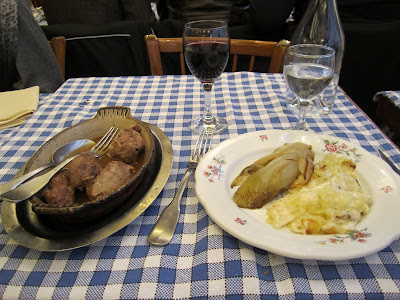
Main course: pig cheeks with potatoes gratin and a vegetable I've had before, can't remember the name of, and don't really like that much. Pig cheeks were delicious, and apparently are the leanest cut of pig you can get.
Finally, crème brulée:

...
Paris was surreal, as perhaps I already expressed here two years ago. I had a lovely visit this time: seeing good friends, eating good food, strolling, and getting my bearings again.
I also saw Chronicle, which was amazing. A really strong, original story with characters that were so close to real that I had to reassure myself I was walking out of a work of fiction at the end. This is in large part thanks to the cinematography (of which you get a good sense in the trailer above), which was thankfully more than a gimmick. In fact, it posed some academic questions I'm still having fun hashing out several weeks later. If you like superhero movies at all and are ready to be proven wrong in your (mostly rightful) preconceptions about high school movies, their characters, and the issues they explore, then go see Chronicle so we can discuss it.
So, as I toured Paris again, I'd have little flashes of my semester abroad and moments in certain places -- kind of like Ben Affleck in that movie Paycheck -- and by the end of three days, I was ready to go before this short vacation turned into really realizing I didn't really have a life here anymore.
So, I went to Budapest.
I'm combining my visits to Lyon and Paris into a single entry, since I've visited both before, and the photos will probably make more statements more effectively than my writing. This is because - and I'm starting to notice it as a trend for my travel entries - the plot is a little thin.
So, here are the photos for Lyon.
And here are the ones for Paris.
Lyon was right between Grenoble and Paris and I'd be damned if I was going to miss out on traditional Lyonnaise food twice. So, the big draw for this visit was Le Musée, located here. As if the #1 rating on TripAdvisor (my go-to for eating when I travel... get your recommendations from them instead of me, and it's basically the same thing) wasn't enough to distinguish it, this restaurant is what they call an official "bouchon."
I mentioned these last time, but a little history lesson is appropriate (now that I actually know the history). In the Great Depression, a lot of (formerly) really rich households in Lyon had to fire their chefs. But, highly skilled cooks being what they are, they didn't have much trouble finding a new market: the public. So, they started up lots of restaurants - "bouchons" - serving good, hot food and just kept doing it. They're very NOT haute-cuisine, but more about a friendly, communal atmosphere. The food focuses on various... let's say "inventive" cuts of meat, so this is not the place to order "just a salad, thanks."
While Lyon is filled with places that advertise themselves as true bouchons, it's generally only the style and atmosphere they mimic, rather than the quality or price. There's a committee dedicated to going around every year and awarding certain restaurants (just under 20, usually) the title of "vrai bouchon Lyonnais" ("true Lyonnaise bouchon"). Which finally brings us back to Le Musée, where we couldn't get a table back in December, but for which I had a reservation this time.
Here's the restaurant. Very cozy.

First up: a piece of brioche bread with a piece of sausage baked in. It was made with love. Literally: I think they have a jar of the stuff, and they sprinkle a little bit on all of the meat they prepare, it tasted that good.

Main course: pig cheeks with potatoes gratin and a vegetable I've had before, can't remember the name of, and don't really like that much. Pig cheeks were delicious, and apparently are the leanest cut of pig you can get.

Finally, crème brulée:

...
Paris was surreal, as perhaps I already expressed here two years ago. I had a lovely visit this time: seeing good friends, eating good food, strolling, and getting my bearings again.
I also saw Chronicle, which was amazing. A really strong, original story with characters that were so close to real that I had to reassure myself I was walking out of a work of fiction at the end. This is in large part thanks to the cinematography (of which you get a good sense in the trailer above), which was thankfully more than a gimmick. In fact, it posed some academic questions I'm still having fun hashing out several weeks later. If you like superhero movies at all and are ready to be proven wrong in your (mostly rightful) preconceptions about high school movies, their characters, and the issues they explore, then go see Chronicle so we can discuss it.
So, as I toured Paris again, I'd have little flashes of my semester abroad and moments in certain places -- kind of like Ben Affleck in that movie Paycheck -- and by the end of three days, I was ready to go before this short vacation turned into really realizing I didn't really have a life here anymore.
So, I went to Budapest.
Wednesday, November 23, 2011
History Lesson
I really wish there was a funicular (uphill/downhill tram) in Grasse.
In fact, before World War II, there was one. For a little while afterward, as well, but then cars came along and people modeled towns around them, and since the recent trend toward public transportation hasn't sunk in yet... But, back in WWII, the Nazis stormed Grasse and destroyed the funicular. My question: Why?
I mean, never mind that anyone occupying Grasse (be they hostiles or recently turned 23) would benefit from a way straight up the hill. No, no -- why would the Nazis bother with Grasse in the first place? If they wasted their time and forces trying to occupy this town, then it's no wonder they lost. I mean, it's cute and all, but if you're going to be a highly organized, thoroughly terrifying regime occupying a small, innocent town, wouldn't you at least pick one closer to the water and less hazy? All I'm saying is that I can't think of that many wars that have been won by cutting off the enemy's perfume supply.
But that got me wondering... Why did French people bother with Grasse? In the first place, I mean. It's not particularly strategic, the slope precludes fertile farmland, and my sources tell me the perfume industry didn't start up 'til the middle ages. Grasse predates the Roman Empire. Why?
The answer is water.
As I've mentioned on numerous occasions, Grasse is a distance from the sea, so this explanation doesn't make much sense. But I've also mentioned on numerous occasions that Grasse is where you start to get into the mountains. Higher up in these mountains are springs that trickle underground through the mountain, but rarely pop up anywhere. It pops up in Grasse, so in the time before acqueducts, fresh water was a big deal.
As for the perfume? By the middle ages, Grasse had become a tannery town (a tannery is where you turn animal hide into leather, etc.). Well-renowned for it, even - serving nobility and royalty - but with one big, blunt problem:
The leather smelled like shit.
That's not just a turn of phrase: made in a tannery, leather is treated with animal droppings. I actually saw and smelled (smelt?) smelt this firsthand in Marrakesh, so it's true, and it's not just Grasse. Anyway, at some point, the brilliant idea was had to treat the leather with perfume to cancel the odor. It continues to work out very well, even if the tanneries that originally inspired this industrial development didn't.
Anyway, I thought this was cool.
-Andy
In fact, before World War II, there was one. For a little while afterward, as well, but then cars came along and people modeled towns around them, and since the recent trend toward public transportation hasn't sunk in yet... But, back in WWII, the Nazis stormed Grasse and destroyed the funicular. My question: Why?
I mean, never mind that anyone occupying Grasse (be they hostiles or recently turned 23) would benefit from a way straight up the hill. No, no -- why would the Nazis bother with Grasse in the first place? If they wasted their time and forces trying to occupy this town, then it's no wonder they lost. I mean, it's cute and all, but if you're going to be a highly organized, thoroughly terrifying regime occupying a small, innocent town, wouldn't you at least pick one closer to the water and less hazy? All I'm saying is that I can't think of that many wars that have been won by cutting off the enemy's perfume supply.
But that got me wondering... Why did French people bother with Grasse? In the first place, I mean. It's not particularly strategic, the slope precludes fertile farmland, and my sources tell me the perfume industry didn't start up 'til the middle ages. Grasse predates the Roman Empire. Why?
The answer is water.
As I've mentioned on numerous occasions, Grasse is a distance from the sea, so this explanation doesn't make much sense. But I've also mentioned on numerous occasions that Grasse is where you start to get into the mountains. Higher up in these mountains are springs that trickle underground through the mountain, but rarely pop up anywhere. It pops up in Grasse, so in the time before acqueducts, fresh water was a big deal.
As for the perfume? By the middle ages, Grasse had become a tannery town (a tannery is where you turn animal hide into leather, etc.). Well-renowned for it, even - serving nobility and royalty - but with one big, blunt problem:
The leather smelled like shit.
That's not just a turn of phrase: made in a tannery, leather is treated with animal droppings. I actually saw and smelled (smelt?) smelt this firsthand in Marrakesh, so it's true, and it's not just Grasse. Anyway, at some point, the brilliant idea was had to treat the leather with perfume to cancel the odor. It continues to work out very well, even if the tanneries that originally inspired this industrial development didn't.
Anyway, I thought this was cool.
-Andy
Subscribe to:
Posts (Atom)